






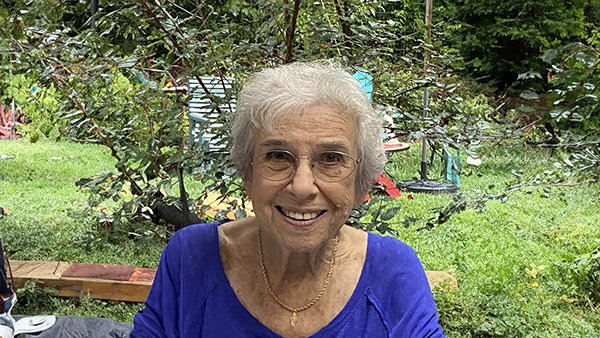
Contemporary Witness Lucy Waldstein
Lucy Waldstein (nee Fischer) was born in December 1930 in Vienna, Austria. She and her sister Inge, 3 years older, went to Grüne Tohr Gasse Schule. Their mother, Liesl Neubauer Fischer, was born in Vienna. She volunteered for the Jewish “Kultusgemeinde.” Lucy’s father, Ernst Otto Fischer, born in Brno Czechoslovakia, was the Chief Editor of the newspaper Kronen Zeitung. They led a comfortable life in the 9th District, frequenting the local parks and cultural attractions.
In July of 1938, acting on a timely warning that her father faced imminent arrest, the family fled Austria overnight. Ernst had a much older son from a previous marriage who was living in England; because of this, they were able to secure a “Capitalist Visa” which allowed them to enter the country, but not work. Lucy and her sister, Inge, were put in a convent boarding school in Folkestone, Kent, England and their parents went to Trinidad, a British Colony, where they were able to try to make a living. Trinidad was one of the few places that was accepting refugees of National Socialism.
Lucy and Inge were separated from their parents. Then they were separated from each other - to facilitate their ability to learn English. After the school year, the young sisters traveled by themselves on a passenger ship to join their parents in Trinidad. Once it was clear that England would enter the war, the family decided that the girls would not be returned to a war zone.
Shortly thereafter, the family was interned by the British for 15 months in barracks surrounded by barbed wire with other “enemy aliens.” There were Jewish families from many European countries in the barracks, about 200 people in total. When they were released from the barracks, Liesl and Ernst did what they could to make a living. Liesl took on odd jobs and Ernst became a Maitre D’ on the American base. They all dreamed of leaving Trinidad for America.
Before the internment, the family had met a wealthy American who had come through Trinidad on a yacht. He signed an affidavit that promised the US government that the Fischers would not be a burden to the country. They were being processed under the Czech quota to come to the United States. In 1944, their father died due to complications from routine surgery.
Their American benefactor redid the paperwork under the Austrian quota without hesitation. Liesl and her daughters were able to emigrate to the US in 1945. Lucy went to Julia Richmond High School in NYC, and then Hunter College and City College, also in NYC. She then went to work in a metal stamping factory to help her family financially; she managed the factory of about 70 workers for 10 years.
In 1958 she married Alex Waldstein. They welcomed Karen in 1959 and then they moved to Chicago, Illinois, where they welcomed Lisa, their second daughter in 1968. The Waldstein family moved back to NYC in 1974. In 1975, Alex passed away. Lucy took over the managing of his 2 mens’ clothing stores in Brooklyn, NY.
5 years later, she and Lisa moved to Maryland to be closer to her sister, Inge, and her family. (Karen was already in university in New York.) Together, Lucy and Inge bought a well established Needlepoint store in Washington, DC frequented by notable clientele such as First Lady Barbara Bush. In 2009, Lucy moved back to New York to be closer to her 2 daughters and her grandson. Because they escaped the clutches of the National Socialist Regime as children, Lucy and Inge went on to enjoy raising families of their own, including (between them) 7 children, 15 grandchildren, and as of today, 8 great grandchildren.
Lucy has shared her story with High School students in New York and she has been interviewed by the Austrian Heritage Collection. Inge’s diary, with entries from 1937 - 1944, was the basis for a play that has been performed in several schools as well as at the Edinburgh Fringe Festival and has since been donated to the American National Holocaust Museum in Washington D.C.
Lucy Waldstein’s family history serves as a stark reminder of the effects of National Socialism. More than 80 years after liberation from the terrorist regime, her story underscores the necessity of remembrance and the ongoing work of defending democracy and human rights.